Think about how many times you've heard the story of Ram, Sita and Lakshman. In a Ramlila, on TV, from a grandparent, in a bhajan. Almost all of it traces back to one person who sat down thousands of years ago and put it into verse. Valmiki Jayanti is the day we remember him.
It's only a few days away now. Not sure about the date? Wondering if it's the same as Sharad Purnima, or who Valmiki actually was? We've tried to answer all of that below, and we've been upfront where stories and history don't line up.
Quick answer
Monday, 26 October 2026. That's Valmiki Jayanti this year, on Ashwin Purnima. It's the day we remember Maharishi Valmiki, the sage said to have written the Ramayana in Sanskrit. People call him Adi Kavi, the first poet, and in much of north India you'll also hear it called Pragat Diwas.
Valmiki Jayanti 2026 timings
Festival date | Monday, 26 October 2026 |
Hindu month and tithi | Ashwin, Shukla Paksha Purnima |
Purnima tithi begins | 25 October 2026, around 11:55 AM |
Purnima tithi ends | 26 October 2026, around 9:41 AM |
Sharad Purnima (same month, different day) | 25 October 2026 |
Other names | Pragat Diwas, Pargat Diwas, Maharishi Valmiki Jayanti |
These are Indian timings. Panchangs can differ by a minute or two (one shows 11:56 AM for the start). Your own city may be slightly off, so ask your pandit ji or check a local panchang.
Is it 25 or 26 October? Why people get confused
Honestly, this is the one everybody asks. Purnima starts around noon on the 25th and carries on till the morning of the 26th. So the evening of the 25th is full moon night, and that's when Sharad Purnima is celebrated.
Valmiki Jayanti goes to the 26th. Panchang dates mostly follow whichever tithi is there at sunrise, and on the 26th the tithi has only just wrapped up. Calendars handle this in slightly different ways, which is why a WhatsApp forward might say one thing and your kid's school circular another. For 2026, the main Indian panchangs we looked at all say 26 October.
Simple way to remember it
25 October: Sharad Purnima, full moon night
26 October: Valmiki Jayanti (Monday)
Does your family or mandir follow a local calendar that says something else? Go with them. They know your community's way best.
Who was Maharishi Valmiki?
People tell it a bit differently, but the core is the same. Valmiki is the rishi behind the Ramayana, around 24,000 shlokas in seven kands, all in Sanskrit. He's called Adi Kavi, the first poet, because tradition says verse began with him. And just about everyone who has told Ram's story since, in song, dance or plain talk, has borrowed from him.
A quick reality check, though. There's no proven birth year for Valmiki, and no real biography. What we have are stories passed down, not records. Even the age of the Ramayana is debated. So if a site gives you his exact birthplace and date, don't take it as gospel. The day still matters, though.
Maharishi Valmiki at a glance
Known as | Adi Kavi (first poet), Maharishi Valmiki |
Famous work | Valmiki Ramayana, in Sanskrit |
Size of the epic | About 24,000 shlokas, 7 kands |
Also credited with | Yog Vasistha (according to tradition) |
Linked to | Ram, Sita, Lav and Kush |
Birth year | Not historically established |
The story of Ratnakar: from robber to sage
This is the most popular story told about Valmiki, and kids love it. Before he became a sage, the story goes, a man named Ratnakar lived by robbing travellers on forest paths. He told himself it was for his family.
One day he stopped the sage Narada. Narada asked a quiet question: when you do all this wrong, will your family share the pap, the burden of it? Ratnakar was sure they would. But when he went home and asked, his wife, his parents, everyone said no. They were happy to eat what he brought, but they would not carry the weight of his actions.
That moment broke something open in him. He went back to Narada, who guided him to meditate on the name of Ram. According to the tale, Ratnakar sat in tapasya for so long that an anthill, a valmik, grew around him. When he finally rose, he was Valmiki, the one born from the anthill.
What the Ratnakar story still teaches us
Own your choices. Nobody else can carry the weight of what you do.
Stop and ask. One honest question changed everything for him.
It's never too late. The story is really about change, not about the past.
A good guide helps. Narada didn't scold him. He asked a question and let Ratnakar find the answer.
Please note: this is a devotional tale, not a verified historical account. Some traditions tell it a little differently, and some scholars question it. We share it here as it's told, and as a lesson.
How the first shloka was born
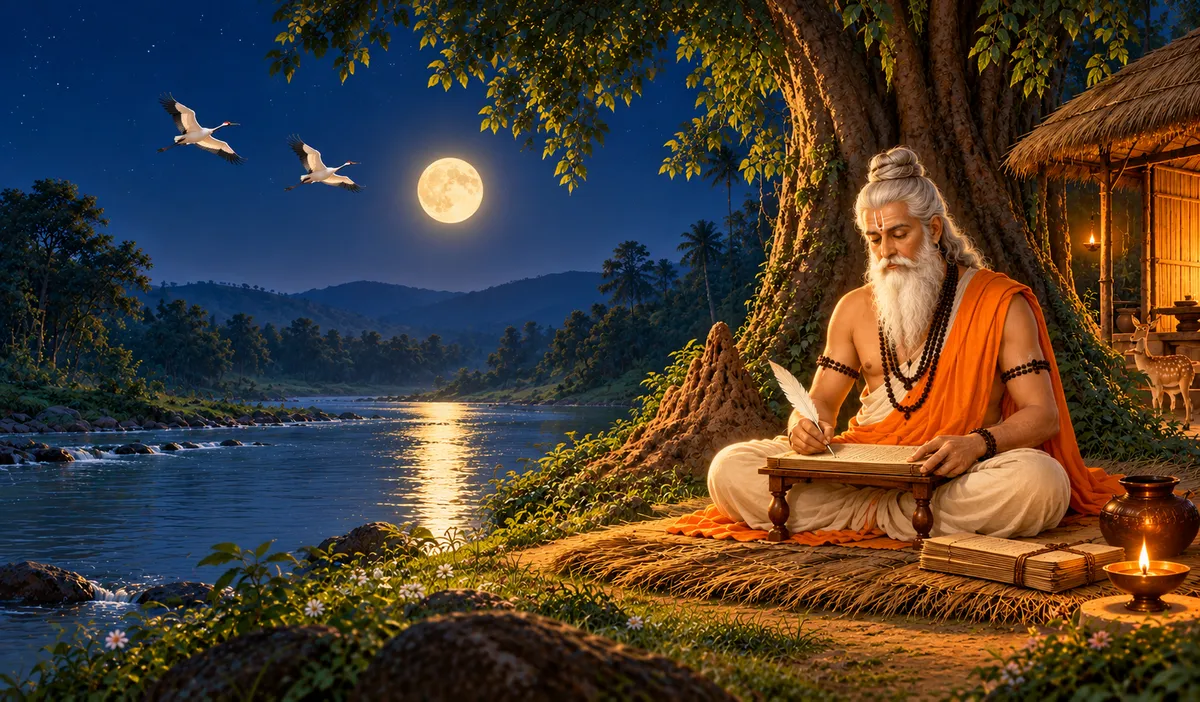
The other famous story is about poetry itself. Valmiki was walking near the Tamasa river with his disciple. They saw a pair of Krauncha birds, a kind of crane, calling to each other. Suddenly a hunter shot one of them. The other bird cried out in grief.
Valmiki was shaken. Angry and sorrowful at once, he spoke a few words, and they came out in a rhythm he hadn't planned. When he noticed it, he realised he had said something in a fixed metre. That, in tradition, was the first shloka.
The first shloka, as tradition remembers it
मा निषाद प्रतिष्ठां त्वमगमः शाश्वतीः समाः।
यत्क्रौञ्चमिथुनादेकमवधीः काममोहितम्॥
Rough meaning: "O hunter, you will not find peace for many years, because you killed one of a loving pair of birds, blinded by desire."
This is the part we love. The very first poem didn't come from wanting to impress anyone. It came from feeling for another creature. Pain turned into verse, which is why people say karuna, deep empathy, runs through the whole Ramayana.
The Ramayana in seven kands
No need to read all 24,000 shlokas to get the layout. Here's a quick map, handy for explaining it to kids or for school revision.
Kand | What happens |
|---|---|
Bal Kand | Ram's birth and childhood, learning under the sages, and his marriage to Sita |
Ayodhya Kand | The plan for Ram's coronation and the events that send him into exile |
Aranya Kand | Life in the forest, and Sita's abduction by Ravan |
Kishkindha Kand | Ram befriends Sugriv, Hanuman enters the story, and the hunt for Sita begins |
Sundar Kand | Hanuman leaps across the sea, reaches Lanka and finally finds Sita |
Yuddha Kand | The war against Ravan and the return to Ayodhya |
Uttar Kand | The aftermath of the war, Sita at Valmiki's ashram, and Lav and Kush |
One thing people often mix up: Tulsidas's Ramcharitmanas, the version many of us grew up with, was written much later, in Awadhi. Valmiki's is the older Sanskrit original, and lots of other Ramayanas across India and Southeast Asia grew out of it.
Valmiki's own place in the story
Here's something people often miss: Valmiki isn't just the author. In the Uttar Kand he walks into his own story. When Sita leaves Ayodhya, it's his ashram that takes her in. Lav and Kush are born there, grow up there, and Valmiki is the one who teaches them, even the Ramayana, which they go on to sing.
Think about that for a second. The man who wrote the story also sheltered one of its most hurting characters, and then handed the story to her children. If that's not what a teacher is, what is?
Why Valmiki Jayanti matters
People mark this day for a few reasons, and not all of them are religious.
He gave us a story to hold on to. Duty, honesty, forgiveness. Most of us first heard these words through the Ramayana.
It's a hopeful story. If Ratnakar could turn his life around, the rest of us can try too.
It brings people together. Bhajans, processions, a shared meal. In parts of north India it's an especially big day for the Valmiki community.
It's a thank-you to teachers and writers, whose work lasts longer than they do.
How Valmiki Jayanti is celebrated
What happens | Details |
|---|---|
Temple prayers | Valmiki temples fill up with flowers and diyas. You'll hear aarti and bhajans all day. |
Shobha yatras | His picture is taken around town on a decorated vehicle, with music and tableaux. |
Ramayana path | Ramayana verses are read or sung in Ram temples, homes and community halls. |
Seva and daan | Free food, clothes and basic supplies for people who need them. A lot of folks save their giving for this day. |
Cultural programmes | Speeches, poems, plays and quizzes, mainly in schools and colleges. |
It varies a lot, even within one city. Just follow your family or local temple.
How to observe it at home
Here's the nice part: there's no single right puja. Keep it short, keep it long, whatever works for you. If you need a place to start, try this.
A simple home routine for Valmiki Jayanti
Tidy the puja corner and light a diya.
Put Valmiki's picture beside your Ram darbar, if you have one.
Flowers, agarbatti, a little prasad. Fruit or mishri is fine.
Read something. A few shlokas, a chapter in translation, or a short story told aloud to the kids.
Sing a bhajan or take Ram naam. Five minutes is enough.
Do one small seva. Feed someone, give away some books or clothes, check on a neighbour.
At dinner, ask everyone what they remember from the Ramayana. You might be surprised.
A few things to keep in mind
Before the day
If your family follows a particular calendar, check with your panchang or pandit ji first.
Keep the day calm. Even 15 quiet minutes with a book or a bhajan counts.
Tell kids the stories softly. The Krauncha birds and Ratnakar usually hold their attention.
Be a little kinder than usual. That's really the point of the day.
Not sure if school or office is closed? Check. It's a holiday in some states and institutions, and not in others.
Ideas for schools and kids
Planning something for a class or for your own kids? Here are a few ideas that tend to go down well.
Storytelling: Let the kids tell Ratnakar's story or the Krauncha story their own way.
Drawing: Valmiki's ashram, the Tamasa river, or the seven kands.
Quiz: Who wrote the Ramayana? How many kands? What does Adi Kavi mean?
Four-line poems: About something that made them feel kind or sad, a bit like Valmiki's first shloka.
Seva drive: Books or snacks for a local shelter.
Valmiki Jayanti dates, 2025 to 2030
Ashwin Purnima doesn't land on the same English date every year, so Valmiki Jayanti keeps moving around October. Here's a handy list.
Year | Date |
|---|---|
2025 | Tuesday, 7 October |
2026 | Monday, 26 October |
2027 | Friday, 15 October |
2028 | Tuesday, 3 October |
2029 | Monday, 22 October |
2030 | Friday, 11 October |
Lessons we can take from Valmiki
Five things worth remembering
Responsibility: Your actions are yours, and no one else can carry them.
Compassion: Our oldest poem started with feeling bad for a hurt bird.
Second chances: You aren't your worst chapter.
Teaching: What you know is worth passing on, the way Valmiki did with Lav and Kush.
Stories: They carry values better than speeches do.
A few wishes you can share
If you'd like to send something to family or friends, these are short and original. Feel free to change the words.
Happy Valmiki Jayanti! May we all find the courage to change and the kindness to forgive.
On Adi Kavi's day, wishing you wisdom, peace and a little more time with good stories.
Final thoughts
If Valmiki's story says anything, it's that where you start isn't where you have to end up. A robber turns sage. Grief turns into poetry. And a story from a forest ashram is still being told, in every language and on every phone.
You don't need a big puja for any of this. A diya, a few lines of the Ramayana, one kind thing, and a chat with your family are enough.
Before 26 October
Mark Monday, 26 October. Sharad Purnima is the day before.
Ask your pandit ji or check a panchang for local timings.
Pick one thing to read, one to sing, one to give.
Tell Ratnakar's story or the Krauncha story to a kid.
School or office? Check the holiday status.
From all of us at Mobile Mandir, Happy Valmiki Jayanti to you and your family.
Frequently asked questions
Here are quick answers to the questions people ask us the most about Valmiki Jayanti.
Monday, 26 October 2026. It falls on Ashwin Purnima, which began on 25 October and ends in the morning of 26 October.
They are linked to the same full moon month, but not the same day this year. Sharad Purnima is on 25 October, while Valmiki Jayanti is on 26 October.
A revered sage who is traditionally credited with composing the Valmiki Ramayana in Sanskrit. He is called Adi Kavi, the first poet. His exact life details are based on tradition rather than historical records.
Because tradition says the first Sanskrit shloka came from him, after he witnessed a hunter kill one of a pair of Krauncha birds.
A devotional tale in which Ratnakar, a robber, realises that his family will not share the burden of his wrongdoing. Guided by Narada, he meditates and becomes Valmiki. It is a traditional narrative, not a verified biography.
Traditionally about 24,000 shlokas in seven kands: Bal, Ayodhya, Aranya, Kishkindha, Sundar, Yuddha and Uttar.
It's a name used in many north Indian communities for the day Valmiki appeared or was born, according to tradition. "Pragat" means revealed or manifested.
Not really. Most families keep it simple: a diya, flowers, Valmiki's picture, some Ramayana verses, a bhajan and a bit of seva.
Depends on where you live and work. Some states and institutions give a holiday and some don't, so check your school or office calendar.
Ram and Sita's twin sons. As per the Uttar Kand, they were born at Valmiki's ashram, where he taught them the Ramayana.
There's no common rule. Some families or communities do keep a fast, so do what your own tradition says.
Through storytelling, drawing, a short quiz, or a small seva activity. The Krauncha bird story is a gentle place to start.