Every year it's the same scene in a lot of houses. Someone sits on the floor shaping a small mountain out of gobar or clay, halwa is cooking in the kitchen, and the kids are fighting over who gets to put the flowers on top.
Govardhan Puja is on Tuesday, 10 November in 2026. It goes back to the story of Krishna lifting a mountain to protect his village. The food is the most special part of the day, offered as Annakut, a mountain of grain. Lakshmi Puja comes two days before it.
Below you'll find the date, the Delhi muhurat, the story, how to do a simple puja at home, what to put in the Annakut, and the mantras. Timings change a bit from city to city, so check your local panchang too.
Govardhan Puja 2026 at a Glance: Date, Tithi and Muhurat
First, the key details: the date, the Pratipada tithi, the morning muhurat for Delhi, and who you pray to. All times are in IST. Your city may be a few minutes off, so look at your local panchang before fixing a time.
Date (India) | Tuesday, 10 November 2026 |
|---|---|
Also known as | Annakut, Padwa, Bali Pratipada, Bestu Varas (Gujarati New Year) |
Tithi | Kartik Shukla Pratipada |
Pratipada (IST) | 12:31 PM on 9 November to 2:00 PM on 10 November |
Morning muhurat, New Delhi | About 6:40 AM to 8:50 AM |
Main deities | Lord Krishna, Giriraj Govardhan, Gau Mata |
What follows | Bhai Dooj on Wednesday, 11 November |
Govardhan Puja Meaning: What Is Annakut?
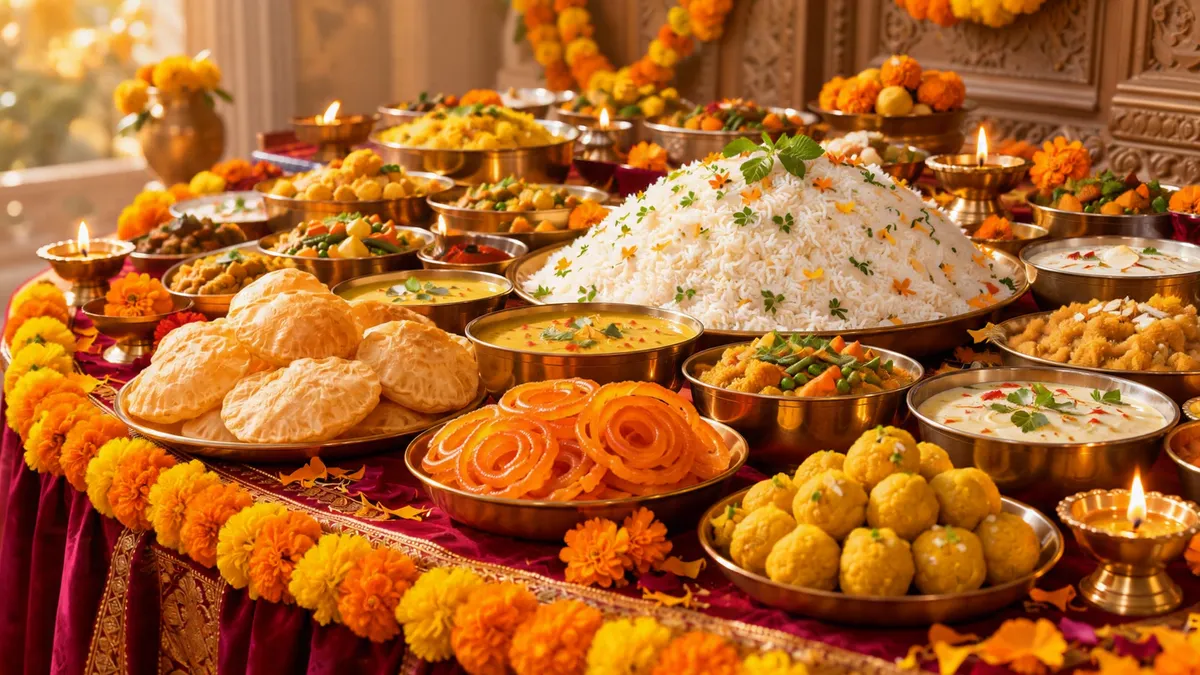
Govardhan Puja is about Krishna lifting Mount Govardhan. People also call it Annakut, which means a heap of grain. Families make a big bhog for Krishna and Giriraj, feed the cows, and then sit down and eat the prasad together.
The tithi is Kartik Shukla Pratipada, which starts the bright fortnight right after the Diwali amavasya. In Gujarat the same day is New Year, called Bestu Varas. In Maharashtra it goes by Bali Pratipada or Padwa.
Plenty of people use Govardhan Puja and Annakut to mean the same day. Worship of the mountain is really one part of the Annakut celebration. It's the fourth day of the five-day Diwali, and our Diwali 2026 guide covers the rest.
Diwali 2026: All Five Days
Diwali is a five-day festival and Govardhan Puja is the fourth day. The table gives each day's date with one line on what it's for. It's handy when you're planning the puja, the cooking and who to visit. Dates are for India.
Day | Date | Festival | In one line |
|---|---|---|---|
1 | Friday, 6 November | Something new for the home and a lamp for protection | |
2 | Sunday, 8 November (morning) | Morning oil bath and evening diyas | |
3 | Sunday, 8 November (evening) | The main night of lamps and prayer | |
4 | Tuesday, 10 November | Annakut, Gau Mata and gratitude | |
5 | Wednesday, 11 November | The festival of brothers and sisters |
Why two days after Diwali? The amavasya runs until 12:31 PM on 9 November, so Pratipada begins after that. Some calendars list Chhoti Diwali on 7 November. We have followed the dates for India.
Govardhan Puja 2026 Muhurat: When to Do the Puja
The puja is done in the morning, when Pratipada tithi is in effect at sunrise. That is why the date falls on 10 November. Below are the tithi timings and the New Delhi muhurat, followed by why some calendars show 9 November.
Event | Time (IST) |
|---|---|
Pratipada begins | 9 November, 12:31 PM |
Pratipada ends | 10 November, 2:00 PM |
Morning muhurat, New Delhi | 10 November, about 6:40 AM to 8:50 AM |
Evening puja | Some families do it after sunset. Check your panchang. |
Bhai Dooj | Wednesday, 11 November |
9 or 10 November? Pratipada starts at 12:31 PM on 9 November, but the puja goes by the tithi at sunrise. In India, that means 10 November. Some temples and calendars abroad show a different date or time, so if you follow a specific tradition, go with your temple.
What If the Morning Muhurat Passes?
This can happen in the morning rush after Diwali. Pratipada is still on until 2:00 PM on 10 November, and some families do the puja in the evening instead. Ask your pandit ji or do what your family does. Don't stress about a few minutes either way.
Govardhan Puja Katha: Krishna, Indra and the Mountain
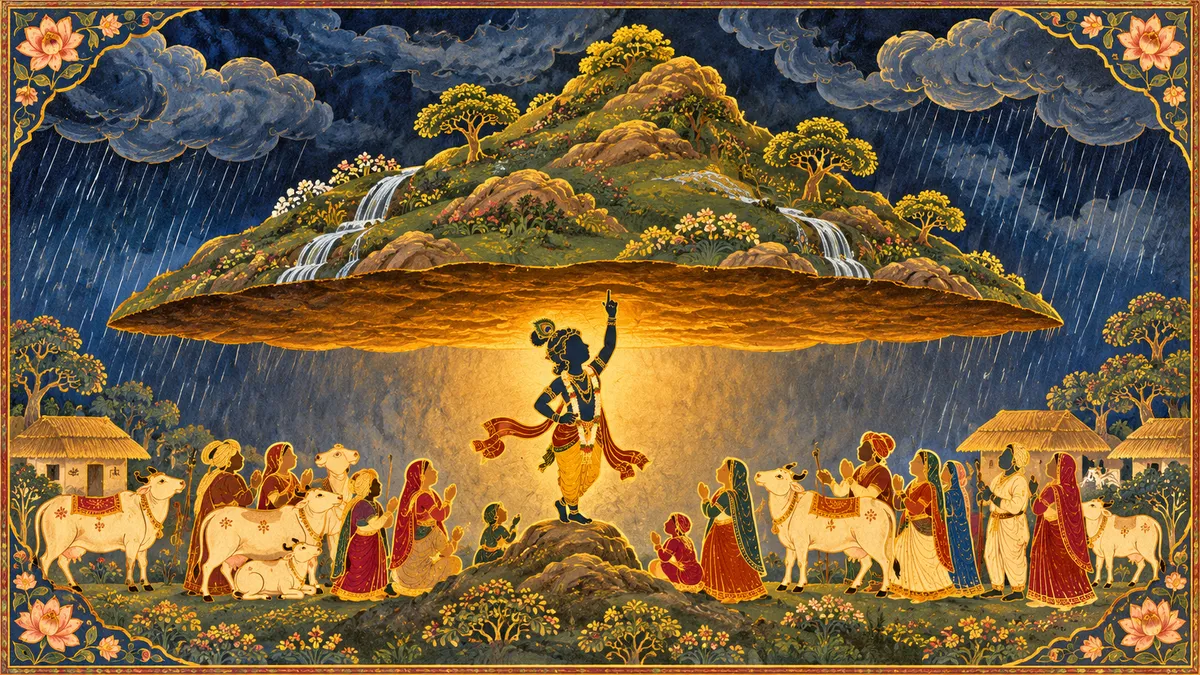
The story is from the Bhagavata Purana, and people in Braj still tell it every year. Little Krishna asks why they offer so much to Indra. What comes next has a storm, a miracle, and a lesson about pride and being thankful.
Krishna's Simple Question
Every year the people of Vrindavan made a large offering to Indra, king of the gods, for good rains. Krishna asked his father the reason. Then he suggested worshipping the mountain that feeds their cows. The villagers agreed.
Indra's Anger
Indra grew angry and sent fierce winds and pouring rain over Vrindavan. Panicked, the people and their animals ran to Krishna. He simply raised Mount Govardhan on his little finger, like an umbrella, and everyone sheltered under it for seven days and seven nights.
Indra Bows Down
On the seventh day Indra understood that Krishna was no ordinary child. He stopped the rain and came with the divine cow Surabhi to ask forgiveness. That day Krishna was called Govinda. The villagers went back to their homes, and Annakut has been part of the festival ever since.
Do You Have to Fast on Govardhan Puja?
Govardhan Puja is mostly about food, so a strict fast isn't really the norm. Plenty of families read or listen to the story before the bhog, and some keep a light fast till the puja is over. Do what your family does.
In short: Krishna told the people of Vrindavan to worship the mountain that feeds their cows. Indra sent a storm in anger. Krishna held up Govardhan for seven days, and in the end Indra bowed his head. The lesson is simple: stay grateful and don't let pride take over.
Who Is Worshipped on Govardhan Puja? Krishna, Giriraj and Gau Mata
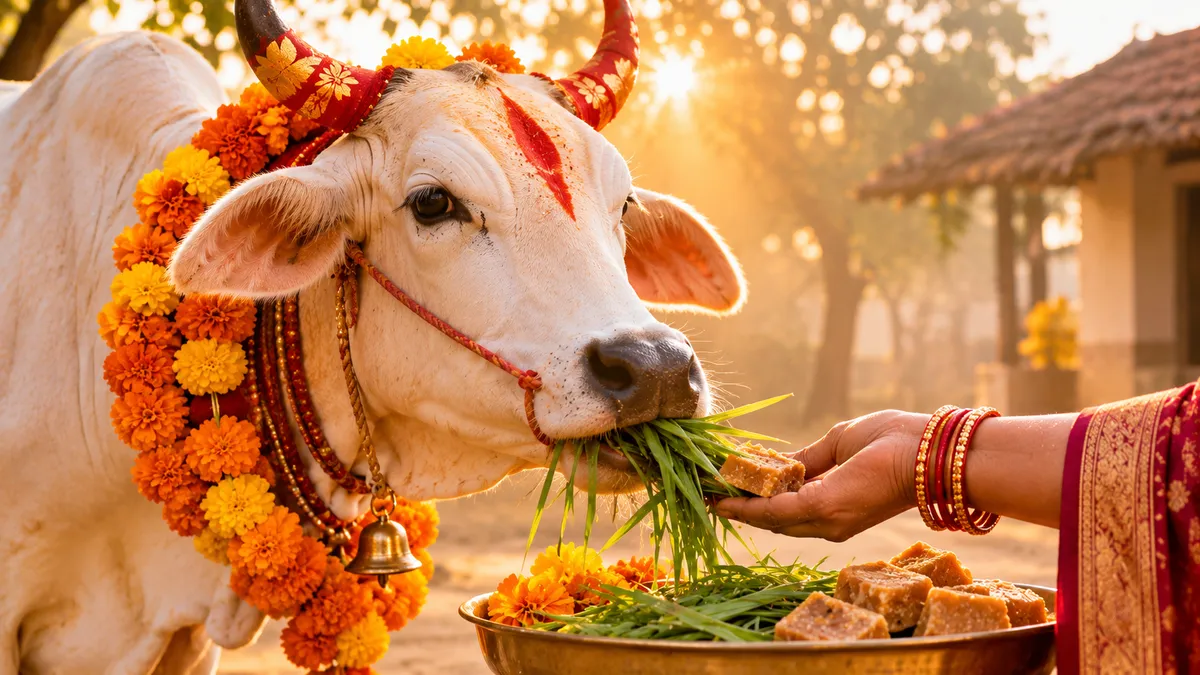
The main deity is Krishna, but the mountain and the cows are honoured just as much on this day. See below who represents what and where to find the aarti. If you want to know more, we also have our gods and goddesses page.
Deity | Role on this day | Symbolises | Aarti or seva |
|---|---|---|---|
Lord Krishna | Main deity | A protective and loving guide | |
Giriraj Govardhan | The mountain that sheltered Braj | Nature that nourishes | |
Gau Mata | Cows are bathed, decorated and fed | Gratitude toward those who nourish us | |
Lord Ganesha | Beginning of every puja | A smooth start |
One note about Gau Seva: it is a paid service carried out by verified partners, with video proof provided. It is not a donation and does not come with an 80G receipt. Families who cannot feed a cow themselves choose it on this day.
Govardhan Puja at Home: Step-by-Step Vidhi
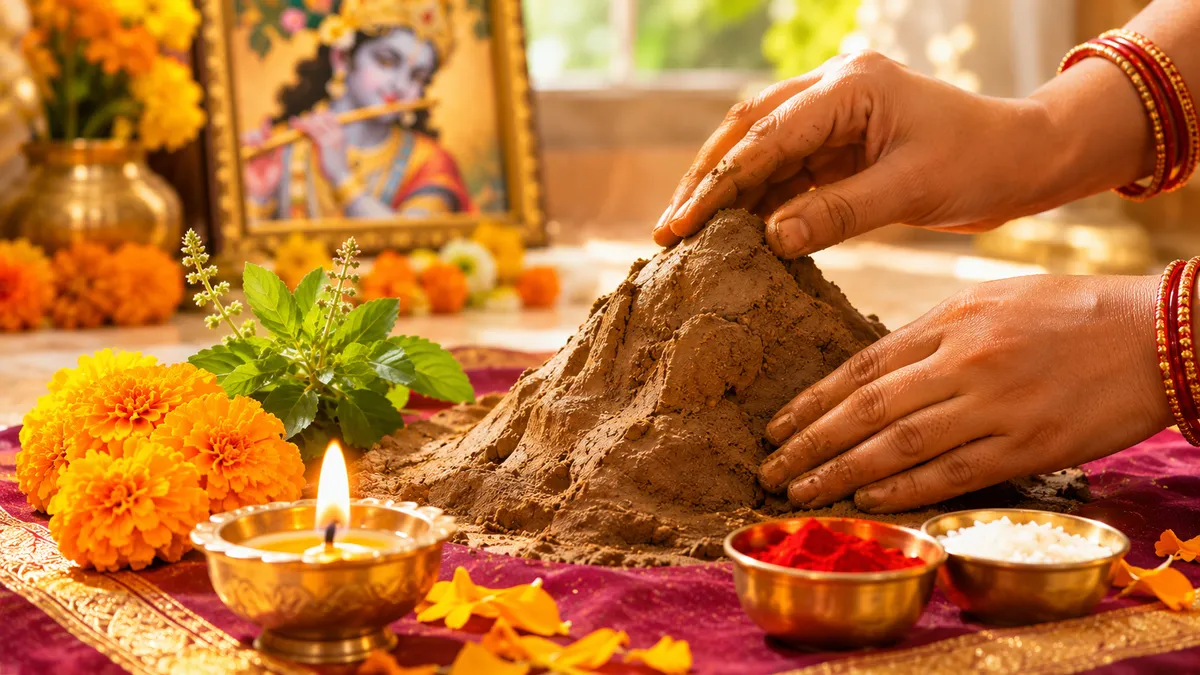
No big arrangements are needed. A small mountain, a picture of Krishna, some food and a few minutes of prayer are enough. Every family has its own custom, so treat these steps as a rough outline and follow your own tradition.
Clean the puja space and the doorway. Make a small rangoli if you like.
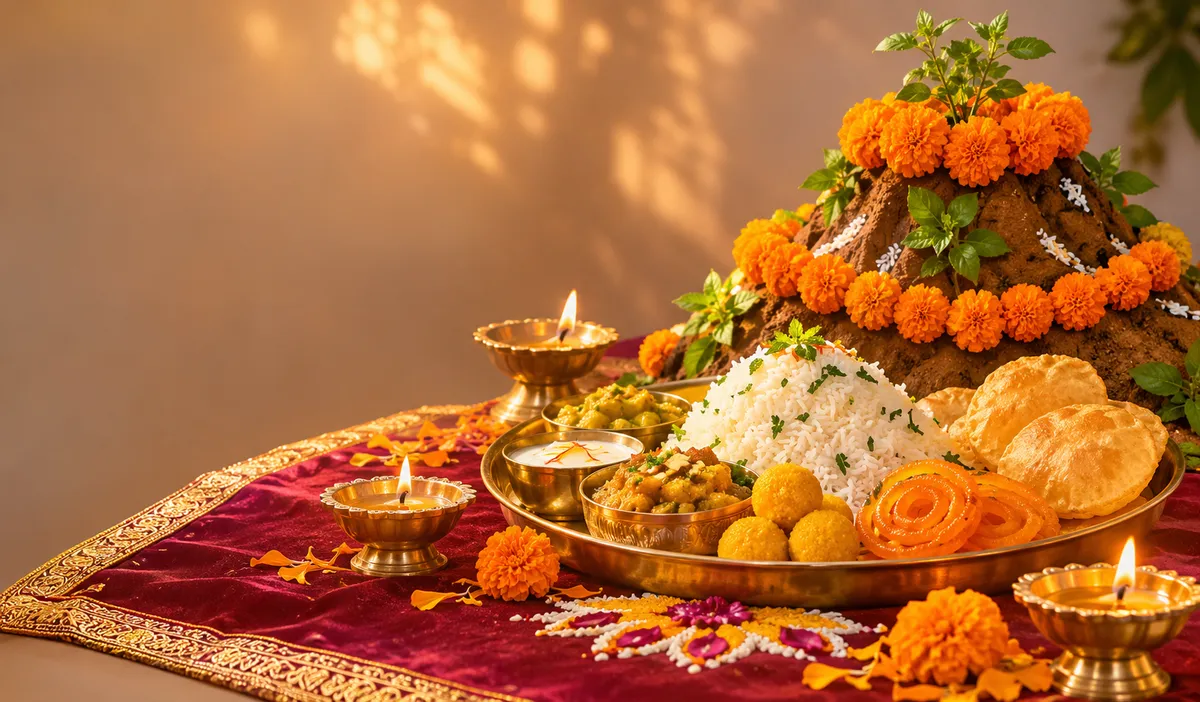
Make Govardhan. Use cow dung or clay. A heap of rice or sweets works too. Decorate it with flowers and tulsi leaves.
Place Krishna beside the mountain. A picture or an idol are both fine. If possible, add small figures of cows.
Light a ghee diya and incense.
Offer roli, rice and flowers to Krishna and Giriraj.
Offer the Annakut bhog. Place freshly cooked food before them. Many families keep it sattvic, without onion and garlic.
Sing the aarti and recite the mantra given below.
Circle the mountain. Walk slowly, clockwise, while chanting.
Honour the cows. If you can, feed a cow fodder, fruit or roti.
Share the prasad with family, neighbours and friends.
Annakut and Chappan Bhog: What to Offer
Annakut means a mountain of grain. Temples set out 56 or more dishes, called Chappan Bhog, but a few simple dishes offered with love at home are enough. Use the thali below as a guide and adjust it to your family's taste.
Type | Examples |
|---|---|
Rice and grains | Plain rice, khichdi, jeera rice |
Dal and kadhi | Moong dal, kadhi, pakoda kadhi |
Vegetables | Seasonal vegetables, potato, paneer |
Roti and puri | Puri, roti, paratha |
Sweets | Kheer, halwa, laddoo, jalebi |
Snacks and fruit | Pakode, kachori, seasonal fruit, dry fruits |
Don't stress about the number of dishes. One dish offered with real faith beats a rushed thali of ten.
What You Need for Govardhan Puja (Samagri)
Get this together the evening before so the morning isn't a rush. You'll find most of it in your kitchen or puja corner already. This is all you need for Govardhan, Krishna puja and Annakut.
Cow dung or clay to make Govardhan
A picture or idol of Lord Krishna
Flowers and a few tulsi leaves
Roli, rice and a ghee diya
Incense sticks and camphor
Cooked food and sweets for Annakut
Water in a small lota
Fodder, fruit or roti for the cows
Govardhan Puja Mantras: What to Chant
A long chant is not necessary. A short mantra spoken slowly and with attention is enough. Families usually recite these two mantras on this day. The verse may vary by tradition, so if your pandit ji has given you a particular version, follow that.
Govardhan Mantra
गोवर्धन धराधार गोकुल त्राणकारक।
विष्णुबाहुकृतोच्छ्राय गवां कोटिप्रदो भव॥
Meaning: O Govardhan, bearer of the earth and protector of Gokul, raised on the arm of Vishnu, bless us with cattle wealth and prosperity.
Hare Krishna Mahamantra
हरे कृष्ण हरे कृष्ण कृष्ण कृष्ण हरे हरे।
हरे राम हरे राम राम राम हरे हरे॥
If you want to count your mala, use the Naam Jaap counter on the app.
Preparing at Home: A Day-by-Day Plan
A little planning makes the morning go smoothly. Below is the order from the evening before the puja to the afternoon of Govardhan Puja, along with when to start cooking so the Annakut is ready on time.
When | What to do |
|---|---|
Before 10 November | Decide the menu and buy vegetables, flour, ghee and flowers. |
Evening of 9 November | Keep the cow dung or clay ready. Take out the puja items. |
10 November, early morning | Cook the Annakut dishes. Bathe and put on clean clothes. |
Morning muhurat | Decorate the mountain, offer the bhog and do the puja and aarti. |
After the puja | Feed the cows if you can, then share the prasad. |
Afternoon or evening | Visit a temple for Annakut darshan if you like. |
Traditions, Safety and Eco-Friendly Tips
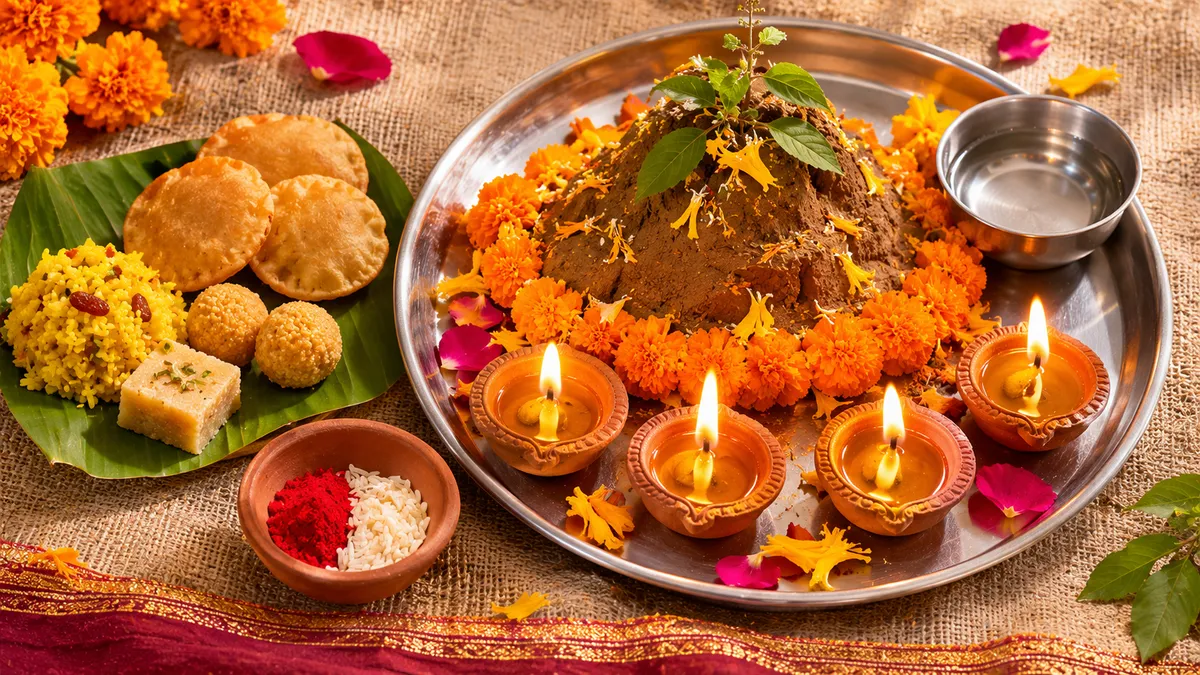
Govardhan Puja looks a little different in every region, and a few easy habits keep the day safe and gentle on the environment. Read the regional traditions first, then the precautions for diyas and food.
Braj (Mathura, Vrindavan, Govardhan): Temples set up huge Annakut displays and devotees do the Govardhan parikrama.
Gujarat: This day is also the New Year, Bestu Varas. People greet each other and visit temples.
Maharashtra: The day is also called Bali Pratipada or Padwa.
Temples: Many temples hold Annakut darshan and distribute prasad to all who come.
Safety: Keep diyas away from curtains and children. Never leave a burning diya unattended.
Food safety: Cook fresh, keep the bhog covered and distribute the prasad the same day.
Environment: Use clay, flowers and leaves, and avoid plastic decorations.
Govardhan Puja: Do's and Don'ts
A few small habits make the day easier: fresh food, a clean mountain and feeding the cows with affection. For a quick look before the muhurat, both sides are placed side by side below.
Do | Don't |
|---|---|
Cook fresh, simple vegetarian food | Offer stale or leftover food |
Check your own city's morning muhurat | Pick up another city's timing |
Feed cows fodder, fruit or roti | Give cows spicy or oily food |
Follow your family's tradition | Argue over regional differences |
Share the prasad the same day | Leave the bhog uncovered in the heat |
Govardhan Puja 2026: Warm Food, a Small Hill and a Thank You
Govardhan Puja is a thank you, plain and simple. The hill, the cows and whoever kept your plate full this year all get a share. A small clay hill and a plate of hot food are enough.
On the morning of 10 November, sit with your family for a few minutes before the cooking takes over. If you have time later, a few rounds of Naam Jaap or one aarti from the aarti section is a nice way to close the day.
If you feel like visiting a temple for Annakut darshan, see temple darshan on the app. You can also read about Govatsa Dwadashi, which honours the cow and calf, and our other festival guides.
Download the Mobile Mandir app from the App Store or Google Play.
Wishing you and your family a happy Govardhan Puja, from all of us at Mobile Mandir.
Frequently Asked Questions
Quick answers to the usual questions, so you can get back to the kitchen.
Tuesday, 10 November. Pratipada starts at 12:31 PM on 9 November and runs till 2:00 PM on 10 November (IST), and the puja is done that morning. Your city can be a few minutes off, so look at your local panchang.
No. Diwali, with Lakshmi Puja in the evening, is on 8 November. Govardhan Puja comes two days later as the fourth day of the festival, and it's about Krishna lifting the mountain.
About 6:40 AM to 8:50 AM on 10 November. Other cities will be a few minutes off. If the morning slips away, some families do the puja in the evening instead.
Pratipada starts at 12:31 PM on 9 November, but the festival goes by the tithi at sunrise, and in India that's 10 November. You may see 9 November on some calendars abroad.
Anna is grain and kut is a heap. Families and temples cook a long spread, stack it up like a hill and offer it to Krishna and Giriraj. Afterwards it all becomes prasad and everyone eats.
Usually not, since it's a food festival. A few families stay on a light fast until the puja is done, but most don't. Do what your elders do.
Krishna is Gopal, the cowherd, and in the story the cows sheltered under the mountain along with the villagers. So on this day cows are bathed, decorated and fed.
No. Fifty-six dishes is what the big temples do. At home, two or three fresh dishes made with devotion are fine.
Yes. Shape a small hill from cow dung or clay, put a picture of Krishna next to it, offer the bhog and sing the aarti. You can ask pandit ji if you'd like, but it's an easy puja to do yourself.
Many families say the Govardhan mantra from this guide, others the Hare Krishna Mahamantra. Pick one and say it slowly. If you like counting rounds, the Naam Jaap counter in the app does that for you.